
The Significance of Holi with Four Celebrated Stories
Holi, the vibrant festival of colours, is deeply rooted in Indian mythology and symbolises the victory of good over evil, love over hatred, and positivity over negativity. One of the most significant legends is of Prahlada and Holika, where unwavering faith defeated arrogance and evil, giving rise to the ritual of Holika Dahan. Another beloved story is of Krishna and Radha, whose playful exchange of colours became a symbol of divine love, equality, and joyful togetherness.
Holi is also connected to the tale of Kamadeva and Shiva, teaching the importance of balancing desire with discipline and honouring sacrifice for a greater good. In another folklore, King Prithu and the defeat of Dhundhi highlight how unity and courage can drive away negativity. Together, these stories make Holi not just a festival of colours but a celebration of faith, love, harmony, and collective strength. 🌸
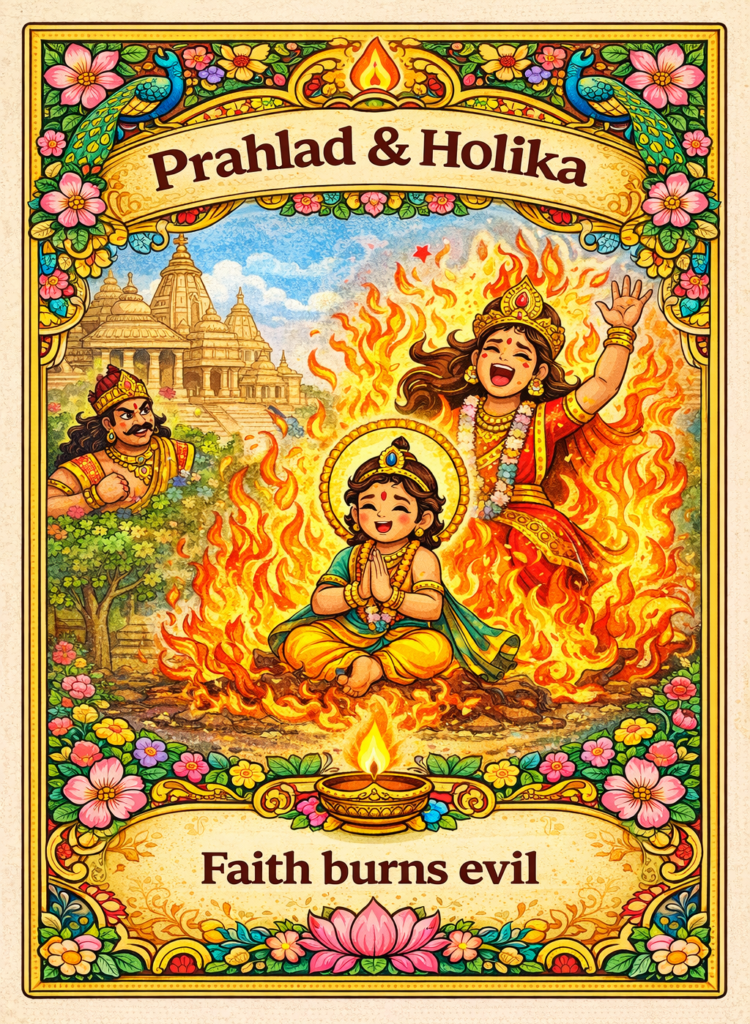
Prahalad & Holika
The story of Prahalad and Holika underscores the triumph of devotion and righteousness over evil. Prahalad, a devoted follower of Lord Vishnu, defied his demon king father’s orders by worshipping Vishnu instead of their demonic gods. Holika, his aunt, who was immune to fire, attempted to kill Prahalad by sitting with him in a blazing fire. However, due to her malicious intent and Prahalad’s unwavering faith, Holika was burnt while Prahalad was unharmed. This tale teaches the importance of steadfast devotion and the victory of good over evil.
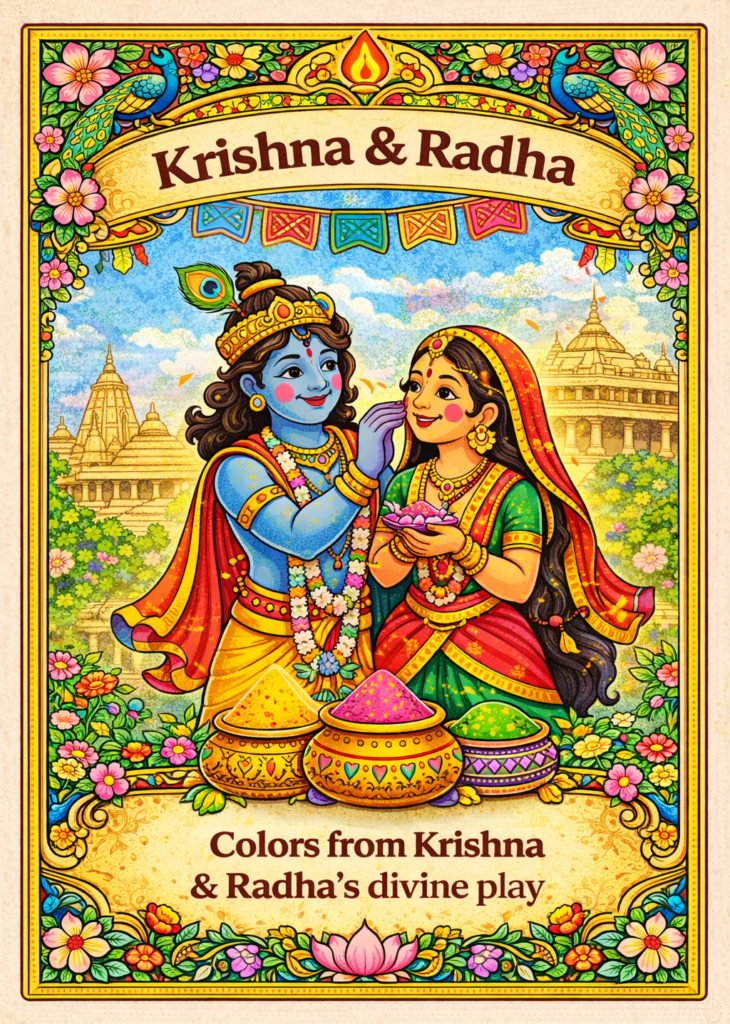
Krishna & Radha
The playful and loving relationship between Lord Krishna and Radha symbolises divine love and joy. Their stories often depict Krishna’s mischievous acts, such as playfully applying colours on Radha and other gopis, which later became a tradition during Holi celebrations. This narrative emphasises love’s power to unite souls beyond social barriers and highlights the joy found in expressing affection freely.
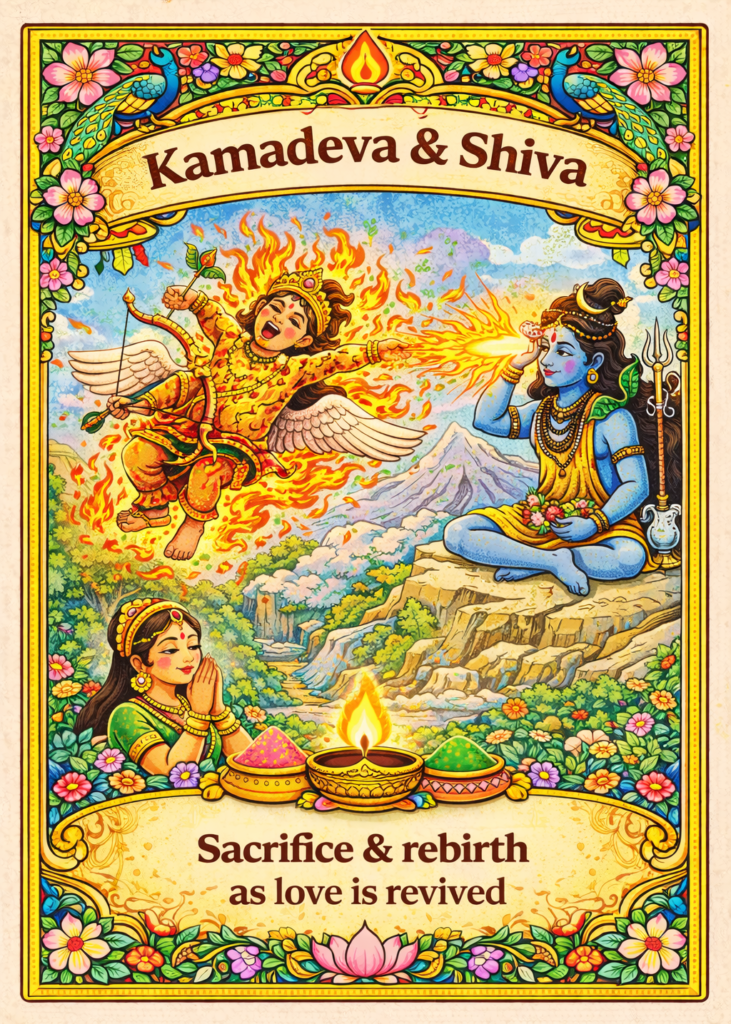
Kamdev & Shiva
The story involving Kamdev, the god of love, and Lord Shiva illustrates the significance of love and desire. When Shiva meditated deeply to attain spiritual enlightenment, Kamdev attempted to disturb his meditation out of love. Shiva, in his anger, burnt Kamdev with his third eye. However, later, Shiva’s compassion revived Kamdev’s life through the intervention of Parvati. This story reminds us that love requires patience and respect for spiritual pursuits.
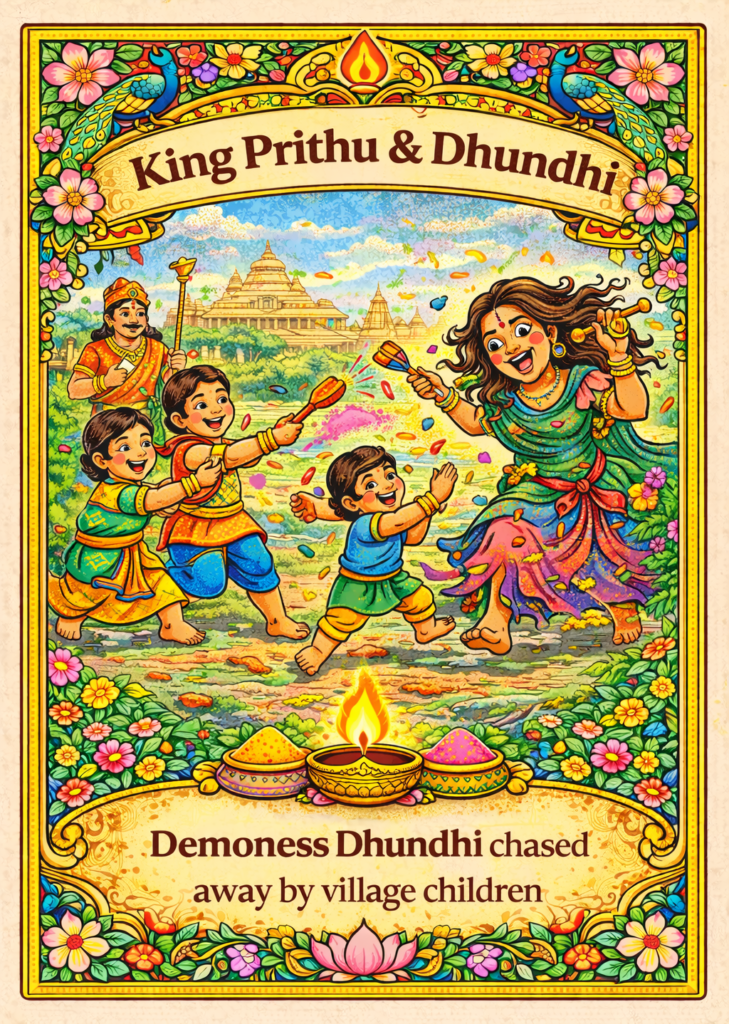
King Prithu & Dhunadhi
The legend of King Prithu and Dhunadhi highlights themes of gratitude and divine blessing. Dhunadhi was a devoted woman who offered her milk to the king’s cattle with pure devotion. Impressed by her sincerity, Prithu blessed her with prosperity and abundance. This tale teaches the value of sincere devotion and the rewards that come from genuine faithfulness in one’s duties.
These stories collectively enrich the cultural fabric of Holi, emphasising virtues such as devotion, love, patience, and gratitude that continue to inspire celebrations today.
Traditions and Celebrations
Holi is celebrated over two days, with the first day known as Holika Dahan or Choti Holi and the second day as Rangwali Holi or Dhuleti.
Holika Dahan: On the eve of Holi, bonfires are lit to symbolise the burning of Holika. People gather around the bonfire, sing and dance, and perform rituals to ward off evil spirits.
Rangwali Holi: The main day of Holi is a colourful affair, with people smearing each other with coloured powders and water. It is a day of fun and frolic, with people of all ages participating in the festivities.
Music and Dance: Holi is also a time for music and dance, with traditional folk songs and dances adding to the festive atmosphere. The joyous spirit of Holi is infectious, and people dance to the beats of the dholak and sing traditional Holi songs.
Special Foods: Like all Indian festivals, Holi is also a time for feasting. Special Holi delicacies like gujiya, mathri, and thandai are prepared and shared with family and friends.
Regional Variations of Holi Celebrations in India
Holi, the festival of colours, is celebrated with fervour and enthusiasm across India. However, the way it is celebrated can vary significantly from region to region, with each area adding its unique cultural flavours to the festival.
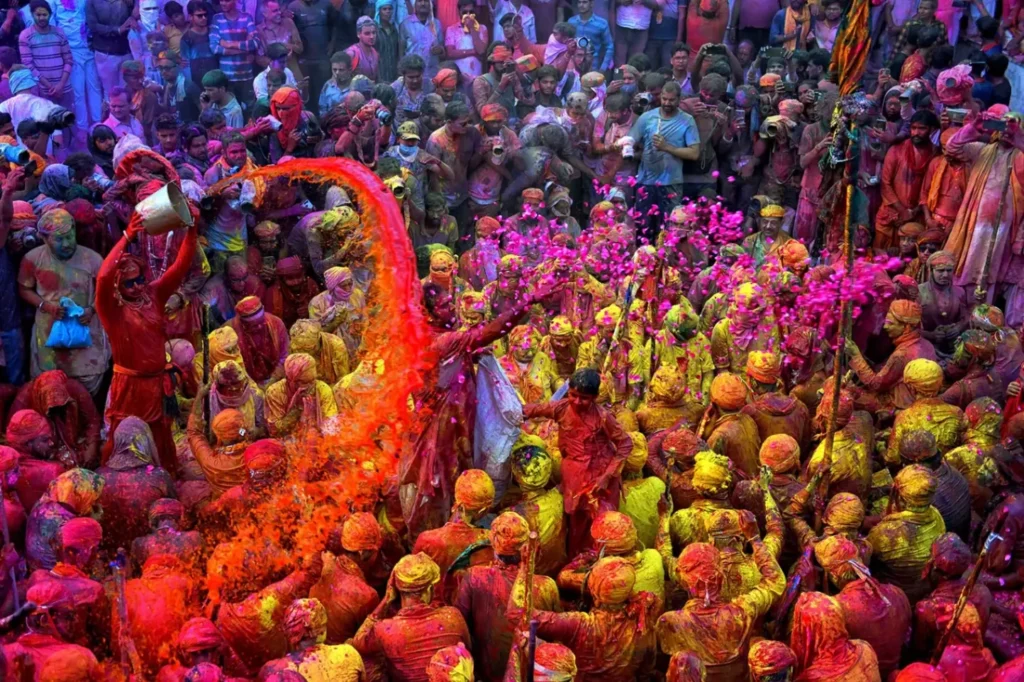
Let’s explore some of the regional variations of Holi in India:
1. Mathura and Vrindavan (Uttar Pradesh)
Lathmar Holi: In Mathura and Vrindavan, the celebration starts a week before the actual date of Holi. Women playfully beat men with sticks (lathis), symbolising the playful teasing of Lord Krishna by the gopis (milkmaids).
Ras Leela: The famous Ras Leela is reenacted, depicting the divine love of Radha and Krishna. It is a major attraction for tourists and devotees alike.
2. Barsana and Nandgaon (Uttar Pradesh)
Lathmar Holi: Similar to Mathura, the women of Barsana village near Mathura playfully beat the men from Nandgaon with sticks.
Nandotsav: In Nandgaon, the men from this village visit Barsana to play Holi with the women there. It is a colourful and lively event.
3. Punjab
Hola Mohalla: Celebrated a day after Holi, Hola Mohalla is an event where Sikhs display their martial skills in mock battles and processions.
4. Gujarat
Dhuleti: In Gujarat, Holi is celebrated as Dhuleti. People dress in white and gather in open spaces to smear coloured powder (gulal) on each other.
Garba and Dandiya Raas: In some parts of Gujarat, especially during Navratri, Holi is celebrated with the traditional folk dances of Garba and Dandiya Raas.
5. West Bengal
Dol Jatra: In West Bengal, Holi is known as Dol Jatra or Dol Purnima. Idols of Radha and Krishna are placed on a decorated palanquin and taken around the streets.
Santiniketan Holi: In Santiniketan, Holi is celebrated as Basanta Utsav (Spring Festival), following the tradition started by Rabindranath Tagore. It includes cultural programmes, dance, and music.
6. Manipur
Yaosang: In Manipur, Holi is celebrated as Yaosang. It lasts for six days and includes traditional Manipuri dance, music, and sports.
7. Maharashtra
Rang Panchami: In Maharashtra, Holi is celebrated as Rang Panchami, where people play with colours and also indulge in cultural activities.
8. South India
Kama Dahanam: In parts of South India, Holi is associated with the legend of Kamadeva, the god of love. Effigies of Kamadeva are burnt to symbolise the triumph of virtue over vice.
These regional variations of Holi highlight the diverse cultural tapestry of India. While the essence of the festival remains the same.
Thanks for choosing us for your Holi celebration! Happy Holi!
: KaRa Gifting Team
